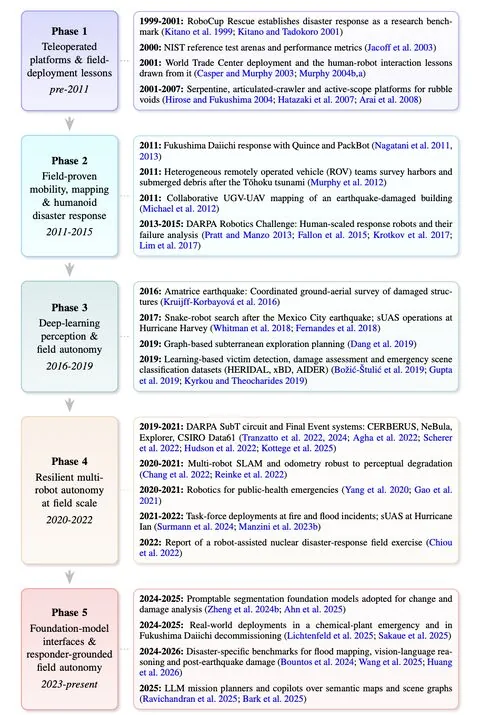
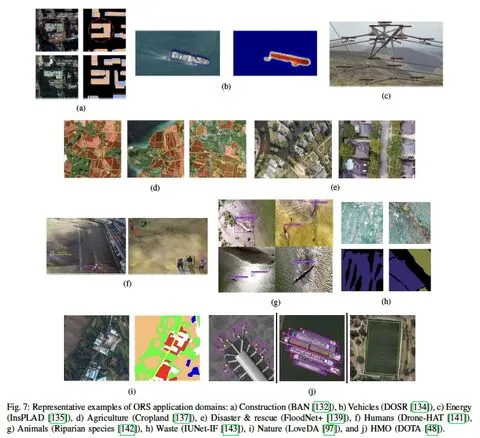
<?xml version="1.0" encoding="utf-8"?><feed xmlns="http://www.w3.org/2005/Atom" xml:lang="en"><generator uri="https://jekyllrb.com/" version="3.10.0">Jekyll</generator><link href="https://gthpapadopoulos.github.io/news/feed.xml" rel="self" type="application/atom+xml" /><link href="https://gthpapadopoulos.github.io/" rel="alternate" type="text/html" hreflang="en" /><updated>2026-11-22T18:40:57+02:00</updated><id>https://gthpapadopoulos.github.io/news/feed.xml</id><title type="html">Georgios Th. Papadopoulos</title><subtitle>Assistant Professor in Computer Graphics and Computational Vision, Department of Informatics and Telematics, Harokopio University of Athens.</subtitle><author><name>Georgios Th. Papadopoulos</name><email>g.th.papadopoulos@hua.gr</email></author><entry><title type="html">New paper | Disaster robotics review</title><link href="https://gthpapadopoulos.github.io/new-paper-disaster-robotics-review/" rel="alternate" type="text/html" title="New paper | Disaster robotics review" /><published>2026-11-19T14:00:00+02:00</published><updated>2026-11-19T14:00:00+02:00</updated><id>https://gthpapadopoulos.github.io/new-paper-disaster-robotics-review</id><content type="html" xml:base="https://gthpapadopoulos.github.io/new-paper-disaster-robotics-review/"><![CDATA[<p>The systematic review “Disaster Robotics in the Deep Learning Era: A Systematic Review of Platforms, Autonomy, Methods, Datasets, Challenges, and Future Research Directions” is now available. It traces the evolution of the field from teleoperated platforms to foundation-model interfaces, while proposing a multi-criteria taxonomy of response tasks, robotic platforms, perception, autonomy, as well as human-robot teaming. Additionally, it introduces a validation maturity axis and reviews the public datasets and benchmarks. The work was carried out within the TRIFFID project by G. Angelidis, A. Psiris, T. Lagkas, V. Argyriou, P. Sarigiannidis, I. Varlamis and G. Th. Papadopoulos.</p>

<p class="post-links"><a href="https://lnkd.in/d9HHch3n">Paper</a></p>

<div class="gallery"><a href="/assets/img/news/2026/li-2026-11-19-new-paper-disaster-robotics-re-2.webp"><img src="/assets/img/news/2026/li-2026-11-19-new-paper-disaster-robotics-re-2.webp" alt="New paper | Disaster robotics review, image 2" loading="lazy" /></a></div>]]></content><author><name>Georgios Th. Papadopoulos</name><email>g.th.papadopoulos@hua.gr</email></author><summary type="html"><![CDATA[The systematic review “Disaster Robotics in the Deep Learning Era: A Systematic Review of Platforms, Autonomy, Methods, Datasets, Challenges, and Future Research Directions” is now available. It traces the evolution of the field from teleoperated platforms to foundation-model interfaces, while proposing a multi-criteria taxonomy of response tasks, robotic platforms, perception, autonomy, as well as human-robot teaming. Additionally, it introduces a validation maturity axis and reviews the public datasets and benchmarks. The work was carried out within the TRIFFID project by G. Angelidis, A. Psiris, T. Lagkas, V. Argyriou, P. Sarigiannidis, I. Varlamis and G. Th. Papadopoulos.]]></summary><media:thumbnail xmlns:media="http://search.yahoo.com/mrss/" url="https://gthpapadopoulos.github.io/assets/img/news/2026/li-2026-11-19-new-paper-disaster-robotics-re-1.jpg" /><media:content medium="image" url="https://gthpapadopoulos.github.io/assets/img/news/2026/li-2026-11-19-new-paper-disaster-robotics-re-1.jpg" xmlns:media="http://search.yahoo.com/mrss/" /></entry><entry><title type="html">Workshop papers | WACV 2027</title><link href="https://gthpapadopoulos.github.io/workshop-papers-wacv-2027/" rel="alternate" type="text/html" title="Workshop papers | WACV 2027" /><published>2026-11-06T14:00:00+02:00</published><updated>2026-11-06T14:00:00+02:00</updated><id>https://gthpapadopoulos.github.io/workshop-papers-wacv-2027</id><content type="html" xml:base="https://gthpapadopoulos.github.io/workshop-papers-wacv-2027/"><![CDATA[<p>Papers on remote sensing and aerial video understanding were accepted at WACV 2027 workshops. “SALT: State-Aligned Low-Rank Transfer for Single-Temporal Cross-Dataset Structural Localization in Remote Sensing” bridges cross-dataset domain gaps through state-aligned low-rank adaptation, without relying on multi-temporal paired data. In parallel, “The Gap Is in the Geometry: A Convergent Meta-Analysis of Multi-Facet Aerial and Remote Sensing Video Understanding” shows that geometric variations are the main performance bottleneck of current methods. Both works were carried out within the TRIFFID project.</p>

<p class="post-links"><a href="https://lnkd.in/dQTv8r4C">Paper (SALT)</a> · <a href="https://lnkd.in/d5yPPDY5">Paper (meta-analysis)</a></p>]]></content><author><name>Georgios Th. Papadopoulos</name><email>g.th.papadopoulos@hua.gr</email></author><summary type="html"><![CDATA[Papers on remote sensing and aerial video understanding were accepted at WACV 2027 workshops. “SALT: State-Aligned Low-Rank Transfer for Single-Temporal Cross-Dataset Structural Localization in Remote Sensing” bridges cross-dataset domain gaps through state-aligned low-rank adaptation, without relying on multi-temporal paired data. In parallel, “The Gap Is in the Geometry: A Convergent Meta-Analysis of Multi-Facet Aerial and Remote Sensing Video Understanding” shows that geometric variations are the main performance bottleneck of current methods. Both works were carried out within the TRIFFID project.]]></summary><media:thumbnail xmlns:media="http://search.yahoo.com/mrss/" url="https://gthpapadopoulos.github.io/assets/img/news/2026/li-2026-11-06-workshop-papers-wacv-2027-1.jpg" /><media:content medium="image" url="https://gthpapadopoulos.github.io/assets/img/news/2026/li-2026-11-06-workshop-papers-wacv-2027-1.jpg" xmlns:media="http://search.yahoo.com/mrss/" /></entry><entry><title type="html">Opinion article | WIRED Greece</title><link href="https://gthpapadopoulos.github.io/opinion-article-wired-greece/" rel="alternate" type="text/html" title="Opinion article | WIRED Greece" /><published>2026-10-08T15:00:00+03:00</published><updated>2026-10-08T15:00:00+03:00</updated><id>https://gthpapadopoulos.github.io/opinion-article-wired-greece</id><content type="html" xml:base="https://gthpapadopoulos.github.io/opinion-article-wired-greece/"><![CDATA[<p>G. Th. Papadopoulos contributed to an opinion article in WIRED Greece on the “Ghost Font”, an experimental tool that hides text within motion in order to confuse AI models. The discussion with the editor V. Tatsiopoulos explains how such visual tricks rely on decades-old psychophysics concepts, such as random-dot kinematograms. Moreover, it explains why current multimodal AI models initially struggle to read them, since they mostly sample videos as sparse static frames rather than processing motion as a continuous signal.</p>

<p class="post-links"><a href="https://wired.com.gr/article/borei-to-ai-na-diavasei-mia-aorati-grammatoseira/">Article</a></p>]]></content><author><name>Georgios Th. Papadopoulos</name><email>g.th.papadopoulos@hua.gr</email></author><summary type="html"><![CDATA[G. Th. Papadopoulos contributed to an opinion article in WIRED Greece on the “Ghost Font”, an experimental tool that hides text within motion in order to confuse AI models. The discussion with the editor V. Tatsiopoulos explains how such visual tricks rely on decades-old psychophysics concepts, such as random-dot kinematograms. Moreover, it explains why current multimodal AI models initially struggle to read them, since they mostly sample videos as sparse static frames rather than processing motion as a continuous signal.]]></summary><media:thumbnail xmlns:media="http://search.yahoo.com/mrss/" url="https://gthpapadopoulos.github.io/assets/img/news/2026/card-2026-10-08-opinion-article-wired-greece.jpg" /><media:content medium="image" url="https://gthpapadopoulos.github.io/assets/img/news/2026/card-2026-10-08-opinion-article-wired-greece.jpg" xmlns:media="http://search.yahoo.com/mrss/" /></entry><entry><title type="html">New paper | IEEE JSTARS</title><link href="https://gthpapadopoulos.github.io/new-paper-ieee-jstars/" rel="alternate" type="text/html" title="New paper | IEEE JSTARS" /><published>2026-10-01T15:00:00+03:00</published><updated>2026-10-01T15:00:00+03:00</updated><id>https://gthpapadopoulos.github.io/new-paper-ieee-jstars</id><content type="html" xml:base="https://gthpapadopoulos.github.io/new-paper-ieee-jstars/"><![CDATA[<p>The systematic review “RGB Optical Remote Sensing in the Deep Learning Era: A Systematic Review of Methods, Models, Datasets, Challenges, and Future Research Directions” was accepted at the IEEE Journal of Selected Topics in Applied Earth Observations and Remote Sensing (JSTARS). It examines how deep learning has transformed optical remote sensing analysis, from handcrafted-feature pipelines to end-to-end learned representations, while outlining the open challenges of the field. The article is authored by P. Koletsis, G. Angelidis, V. Efthymiou, D. Michail, C. Chalkias, T. Lagkas, P. Sarigiannidis and G. Th. Papadopoulos.</p>

<p class="post-links"><a href="https://lnkd.in/d2PPpqg3">Paper</a></p>

<div class="gallery"><a href="/assets/img/news/2026/li-2026-10-01-new-paper-ieee-jstars-2.webp"><img src="/assets/img/news/2026/li-2026-10-01-new-paper-ieee-jstars-2.webp" alt="New paper | IEEE JSTARS, image 2" loading="lazy" /></a></div>]]></content><author><name>Georgios Th. Papadopoulos</name><email>g.th.papadopoulos@hua.gr</email></author><summary type="html"><![CDATA[The systematic review “RGB Optical Remote Sensing in the Deep Learning Era: A Systematic Review of Methods, Models, Datasets, Challenges, and Future Research Directions” was accepted at the IEEE Journal of Selected Topics in Applied Earth Observations and Remote Sensing (JSTARS). It examines how deep learning has transformed optical remote sensing analysis, from handcrafted-feature pipelines to end-to-end learned representations, while outlining the open challenges of the field. The article is authored by P. Koletsis, G. Angelidis, V. Efthymiou, D. Michail, C. Chalkias, T. Lagkas, P. Sarigiannidis and G. Th. Papadopoulos.]]></summary><media:thumbnail xmlns:media="http://search.yahoo.com/mrss/" url="https://gthpapadopoulos.github.io/assets/img/news/2026/li-2026-10-01-new-paper-ieee-jstars-1.jpg" /><media:content medium="image" url="https://gthpapadopoulos.github.io/assets/img/news/2026/li-2026-10-01-new-paper-ieee-jstars-1.jpg" xmlns:media="http://search.yahoo.com/mrss/" /></entry><entry><title type="html">Paper accepted | NeurIPS 2026</title><link href="https://gthpapadopoulos.github.io/paper-accepted-neurips-2026/" rel="alternate" type="text/html" title="Paper accepted | NeurIPS 2026" /><published>2026-09-24T15:00:00+03:00</published><updated>2026-09-24T15:00:00+03:00</updated><id>https://gthpapadopoulos.github.io/paper-accepted-neurips-2026</id><content type="html" xml:base="https://gthpapadopoulos.github.io/paper-accepted-neurips-2026/"><![CDATA[<p>The paper “GATE-AD: Graph Attention Network Encoding For Few-Shot Industrial Visual Anomaly Detection” was accepted at the NeurIPS 2026 Main Track as a poster presentation. The work introduces a reconstruction-based approach to few-shot industrial visual anomaly detection, which relies on a graph attention network encoder. It was carried out by the PhD student A. Psiris, together with Y. Panagakis and M. Vakalopoulou from the Archimedes Research Unit, as well as G. Th. Papadopoulos, within the TORNADO project.</p>

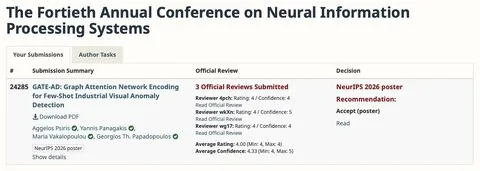
<p class="post-links"><a href="https://lnkd.in/dEJjYyjR">Paper (arXiv)</a> · <a href="https://lnkd.in/dqx5iqFV">Code</a></p>

<div class="gallery"><a href="/assets/img/news/2026/li-2026-09-24-paper-accepted-neurips-2026-2.webp"><img src="/assets/img/news/2026/li-2026-09-24-paper-accepted-neurips-2026-2.webp" alt="Paper accepted | NeurIPS 2026, image 2" loading="lazy" /></a></div>]]></content><author><name>Georgios Th. Papadopoulos</name><email>g.th.papadopoulos@hua.gr</email></author><summary type="html"><![CDATA[The paper “GATE-AD: Graph Attention Network Encoding For Few-Shot Industrial Visual Anomaly Detection” was accepted at the NeurIPS 2026 Main Track as a poster presentation. The work introduces a reconstruction-based approach to few-shot industrial visual anomaly detection, which relies on a graph attention network encoder. It was carried out by the PhD student A. Psiris, together with Y. Panagakis and M. Vakalopoulou from the Archimedes Research Unit, as well as G. Th. Papadopoulos, within the TORNADO project.]]></summary><media:thumbnail xmlns:media="http://search.yahoo.com/mrss/" url="https://gthpapadopoulos.github.io/assets/img/news/2026/li-2026-09-24-paper-accepted-neurips-2026-1.jpg" /><media:content medium="image" url="https://gthpapadopoulos.github.io/assets/img/news/2026/li-2026-09-24-paper-accepted-neurips-2026-1.jpg" xmlns:media="http://search.yahoo.com/mrss/" /></entry><entry><title type="html">Conference | SEEDA-CECNSM 2026</title><link href="https://gthpapadopoulos.github.io/conference-seeda-cecnsm-2026/" rel="alternate" type="text/html" title="Conference | SEEDA-CECNSM 2026" /><published>2026-09-18T15:00:00+03:00</published><updated>2026-09-18T15:00:00+03:00</updated><id>https://gthpapadopoulos.github.io/conference-seeda-cecnsm-2026</id><content type="html" xml:base="https://gthpapadopoulos.github.io/conference-seeda-cecnsm-2026/"><![CDATA[<p>G. Th. Papadopoulos participated in the SEEDA-CECNSM 2026 conference, held at the Aristotle University Research Dissemination Center (KEDEA) in Thessaloniki, Greece. Joint works were presented on the forensic readiness of agentic AI and on synthetic investigation data. The first one, “HANSARD: A Reference Architecture for Forensic Readiness, Runtime Witnessing, and Graded Attribution in Autonomous Multi-Agent AI Systems”, is authored by C. Sardianos et al. The second one, “CaseBundleGen: LLM-Driven Generation of Synthetic Multimodal Data Lake Cases”, is authored by C. Panagiotopoulos et al.</p>

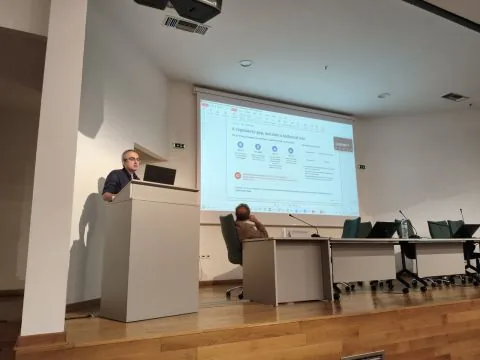
<div class="gallery"><a href="/assets/img/news/2026/li-2026-09-18-conference-seeda-cecnsm-2026-2.webp"><img src="/assets/img/news/2026/li-2026-09-18-conference-seeda-cecnsm-2026-2.webp" alt="Conference | SEEDA-CECNSM 2026, image 2" loading="lazy" /></a></div>]]></content><author><name>Georgios Th. Papadopoulos</name><email>g.th.papadopoulos@hua.gr</email></author><summary type="html"><![CDATA[G. Th. Papadopoulos participated in the SEEDA-CECNSM 2026 conference, held at the Aristotle University Research Dissemination Center (KEDEA) in Thessaloniki, Greece. Joint works were presented on the forensic readiness of agentic AI and on synthetic investigation data. The first one, “HANSARD: A Reference Architecture for Forensic Readiness, Runtime Witnessing, and Graded Attribution in Autonomous Multi-Agent AI Systems”, is authored by C. Sardianos et al. The second one, “CaseBundleGen: LLM-Driven Generation of Synthetic Multimodal Data Lake Cases”, is authored by C. Panagiotopoulos et al.]]></summary><media:thumbnail xmlns:media="http://search.yahoo.com/mrss/" url="https://gthpapadopoulos.github.io/assets/img/news/2026/li-2026-09-18-conference-seeda-cecnsm-2026-1.jpg" /><media:content medium="image" url="https://gthpapadopoulos.github.io/assets/img/news/2026/li-2026-09-18-conference-seeda-cecnsm-2026-1.jpg" xmlns:media="http://search.yahoo.com/mrss/" /></entry><entry><title type="html">New paper | Neurocomputing</title><link href="https://gthpapadopoulos.github.io/new-paper-neurocomputing/" rel="alternate" type="text/html" title="New paper | Neurocomputing" /><published>2026-08-12T15:00:00+03:00</published><updated>2026-08-12T15:00:00+03:00</updated><id>https://gthpapadopoulos.github.io/new-paper-neurocomputing</id><content type="html" xml:base="https://gthpapadopoulos.github.io/new-paper-neurocomputing/"><![CDATA[<p>The review “Visual hand gesture recognition with deep learning: A comprehensive review of methods, datasets, challenges and future research directions” was accepted at Elsevier Neurocomputing. It provides an overview of deep-learning-based visual hand gesture recognition, covering the main methods, datasets and evaluation practices, while discussing the open challenges and future research directions of the field. The article is authored by K. Foteinos, M. Linardakis, P. Radoglou-Grammatikis, V. Argyriou, P. Sarigiannidis, I. Varlamis and G. Th. Papadopoulos, within the TORNADO project.</p>

<p class="post-links"><a href="https://lnkd.in/gmvFHkDh">Paper</a></p>]]></content><author><name>Georgios Th. Papadopoulos</name><email>g.th.papadopoulos@hua.gr</email></author><summary type="html"><![CDATA[The review “Visual hand gesture recognition with deep learning: A comprehensive review of methods, datasets, challenges and future research directions” was accepted at Elsevier Neurocomputing. It provides an overview of deep-learning-based visual hand gesture recognition, covering the main methods, datasets and evaluation practices, while discussing the open challenges and future research directions of the field. The article is authored by K. Foteinos, M. Linardakis, P. Radoglou-Grammatikis, V. Argyriou, P. Sarigiannidis, I. Varlamis and G. Th. Papadopoulos, within the TORNADO project.]]></summary><media:thumbnail xmlns:media="http://search.yahoo.com/mrss/" url="https://gthpapadopoulos.github.io/assets/img/news/2026/li-2026-08-12-new-paper-neurocomputing-1.jpg" /><media:content medium="image" url="https://gthpapadopoulos.github.io/assets/img/news/2026/li-2026-08-12-new-paper-neurocomputing-1.jpg" xmlns:media="http://search.yahoo.com/mrss/" /></entry><entry><title type="html">Conference | IEEE CISOSE 2026</title><link href="https://gthpapadopoulos.github.io/conference-ieee-cisose-2026/" rel="alternate" type="text/html" title="Conference | IEEE CISOSE 2026" /><published>2026-07-29T15:00:00+03:00</published><updated>2026-07-29T15:00:00+03:00</updated><id>https://gthpapadopoulos.github.io/conference-ieee-cisose-2026</id><content type="html" xml:base="https://gthpapadopoulos.github.io/conference-ieee-cisose-2026/"><![CDATA[<p>G. Th. Papadopoulos and I. Varlamis participated in the IEEE CISOSE 2026 conference, hosted by the Fukuoka Institute of Technology in Fukuoka, Japan. Joint works were presented on facial affect analysis for service-oriented systems, as well as on sustainable face recognition on low-power devices with VQ-VAE embeddings. The first one reviews the advances, challenges and future visions of facial affect analysis, while the second one targets energy-efficient face recognition. Both works were supported by the TORNADO project.</p>

<p class="post-links"><a href="https://lnkd.in/dQHNKqb8">Paper (facial affect)</a> · <a href="https://lnkd.in/dCJ7pytP">Paper (face recognition)</a></p>]]></content><author><name>Georgios Th. Papadopoulos</name><email>g.th.papadopoulos@hua.gr</email></author><summary type="html"><![CDATA[G. Th. Papadopoulos and I. Varlamis participated in the IEEE CISOSE 2026 conference, hosted by the Fukuoka Institute of Technology in Fukuoka, Japan. Joint works were presented on facial affect analysis for service-oriented systems, as well as on sustainable face recognition on low-power devices with VQ-VAE embeddings. The first one reviews the advances, challenges and future visions of facial affect analysis, while the second one targets energy-efficient face recognition. Both works were supported by the TORNADO project.]]></summary><media:thumbnail xmlns:media="http://search.yahoo.com/mrss/" url="https://gthpapadopoulos.github.io/assets/img/news/2026/li-2026-07-29-conference-ieee-cisose-2026-1.jpg" /><media:content medium="image" url="https://gthpapadopoulos.github.io/assets/img/news/2026/li-2026-07-29-conference-ieee-cisose-2026-1.jpg" xmlns:media="http://search.yahoo.com/mrss/" /></entry><entry><title type="html">RSS 2027 | Coming to Greece</title><link href="https://gthpapadopoulos.github.io/rss-2027-coming-to-greece/" rel="alternate" type="text/html" title="RSS 2027 | Coming to Greece" /><published>2026-07-20T15:00:00+03:00</published><updated>2026-07-20T15:00:00+03:00</updated><id>https://gthpapadopoulos.github.io/rss-2027-coming-to-greece</id><content type="html" xml:base="https://gthpapadopoulos.github.io/rss-2027-coming-to-greece/"><![CDATA[<p>The Robotics: Science and Systems conference (RSS 2027) will take place in Athens, Greece, while Harokopio University of Athens will co-host it. The initiative is coordinated by Prof. Kostas Daniilidis, who made the formal announcement during RSS 2026 in Sydney. The organizing committee further includes S. Nikolaidis, G. Pappas, L. E. Kavraki, A. Argyros, G. Chalvatzaki, D. Kanoulas, P. Maragos and M. Chli. The conference provides an important opportunity for the Greek robotics community.</p>

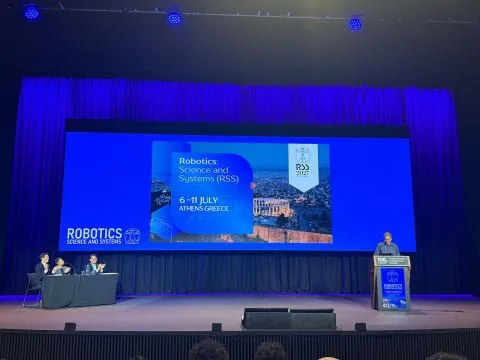
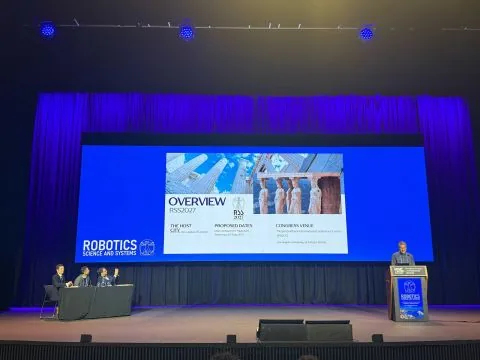
<p class="post-links"><a href="https://roboticsconference.org">Website</a></p>

<div class="gallery"><a href="/assets/img/news/2026/li-2026-07-20-rss-2027-coming-to-greece-2.webp"><img src="/assets/img/news/2026/li-2026-07-20-rss-2027-coming-to-greece-2.webp" alt="RSS 2027 | Coming to Greece, image 2" loading="lazy" /></a><a href="/assets/img/news/2026/li-2026-07-20-rss-2027-coming-to-greece-3.webp"><img src="/assets/img/news/2026/li-2026-07-20-rss-2027-coming-to-greece-3.webp" alt="RSS 2027 | Coming to Greece, image 3" loading="lazy" /></a></div>]]></content><author><name>Georgios Th. Papadopoulos</name><email>g.th.papadopoulos@hua.gr</email></author><summary type="html"><![CDATA[The Robotics: Science and Systems conference (RSS 2027) will take place in Athens, Greece, while Harokopio University of Athens will co-host it. The initiative is coordinated by Prof. Kostas Daniilidis, who made the formal announcement during RSS 2026 in Sydney. The organizing committee further includes S. Nikolaidis, G. Pappas, L. E. Kavraki, A. Argyros, G. Chalvatzaki, D. Kanoulas, P. Maragos and M. Chli. The conference provides an important opportunity for the Greek robotics community.]]></summary><media:thumbnail xmlns:media="http://search.yahoo.com/mrss/" url="https://gthpapadopoulos.github.io/assets/img/news/2026/li-2026-07-20-rss-2027-coming-to-greece-1.jpg" /><media:content medium="image" url="https://gthpapadopoulos.github.io/assets/img/news/2026/li-2026-07-20-rss-2027-coming-to-greece-1.jpg" xmlns:media="http://search.yahoo.com/mrss/" /></entry><entry><title type="html">New paper | TMLR</title><link href="https://gthpapadopoulos.github.io/new-paper-tmlr/" rel="alternate" type="text/html" title="New paper | TMLR" /><published>2026-07-16T15:00:00+03:00</published><updated>2026-07-16T15:00:00+03:00</updated><id>https://gthpapadopoulos.github.io/new-paper-tmlr</id><content type="html" xml:base="https://gthpapadopoulos.github.io/new-paper-tmlr/"><![CDATA[<p>The review “Foundation Models in Robotics: A Comprehensive Review of Methods, Models, Datasets, Challenges and Future Research Directions” was accepted at Transactions on Machine Learning Research (TMLR). It analyzes the shift of robotics from fixed, single-task, domain-specific solutions towards adaptive, general-purpose agents, which are powered by foundation models. The article is authored by A. Psiris, V. Argyriou, E. Markakis, P. Sarigiannidis, E. Gavves, K. Bekris, A. Ajoudani and G. Th. Papadopoulos, within the TORNADO project.</p>

<p class="post-links"><a href="https://lnkd.in/d4eJ2mWt">Paper</a></p>]]></content><author><name>Georgios Th. Papadopoulos</name><email>g.th.papadopoulos@hua.gr</email></author><summary type="html"><![CDATA[The review “Foundation Models in Robotics: A Comprehensive Review of Methods, Models, Datasets, Challenges and Future Research Directions” was accepted at Transactions on Machine Learning Research (TMLR). It analyzes the shift of robotics from fixed, single-task, domain-specific solutions towards adaptive, general-purpose agents, which are powered by foundation models. The article is authored by A. Psiris, V. Argyriou, E. Markakis, P. Sarigiannidis, E. Gavves, K. Bekris, A. Ajoudani and G. Th. Papadopoulos, within the TORNADO project.]]></summary><media:thumbnail xmlns:media="http://search.yahoo.com/mrss/" url="https://gthpapadopoulos.github.io/assets/img/news/2026/li-2026-07-16-new-paper-tmlr-1.jpg" /><media:content medium="image" url="https://gthpapadopoulos.github.io/assets/img/news/2026/li-2026-07-16-new-paper-tmlr-1.jpg" xmlns:media="http://search.yahoo.com/mrss/" /></entry></feed>